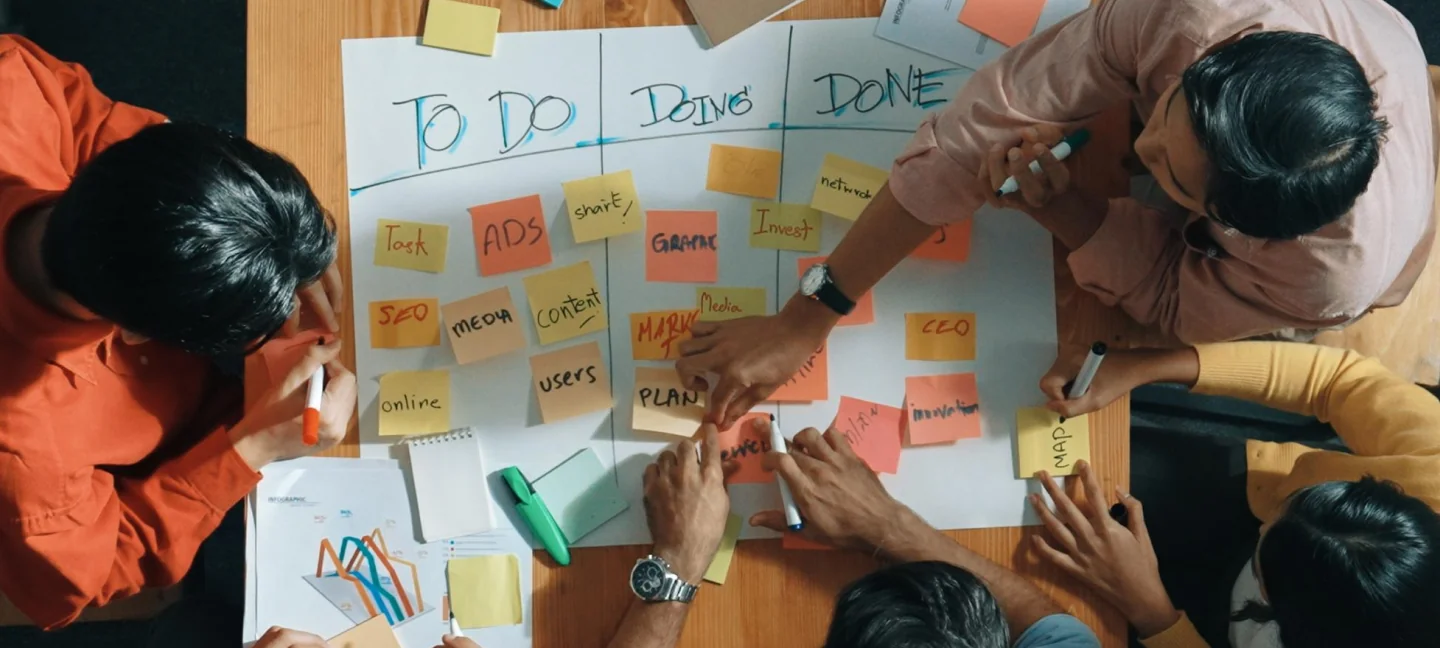
If you work in project management, you know there are many different methods to choose from. Picking the right project methodology is critical to the success of your delivery. In this article, I’m going to discuss two project management approaches Waterfall and Agile project management.
What is the Waterfall project management methodology?
Waterfall project management is a linear process with sequential phases. A phase begins only once the previous stage is completed entirely. Waterfall project management was not initially designed for the software industry. It was used in areas like industries like manufacturing and construction, where the phases must happen sequentially.
Because the process has no turning back, the project’s requirement and each team member’s role should be clear to everyone involved.
The phases usually progress in this manner:
While Waterfall methodology has its clear benefits, it fails when the requirements of the project are unclear
In such cases, an excellent alternative is an Agile methodology
What is the Agile methodology?
Agile methodology is a method of project management with a systematic, iterative approach whose aim is continuous releases and incorporating customer feedback with every iteration. Agile teams are designed to be well agile in their development speed and respond well to market trends.
There are four Core Values in the Agile methodology.
The basic processes in the Agile methodology are:
Here is a comparison of the Waterfall and Agile methodologies
|
|
Waterfall |
Agile |
|
Methodology |
The Waterfall process is always sequential with pre-defined phases—first research, then design. Development begins only after a sign-off from the design team. |
The Agile process is iterative. Researchers, designers, developers, testers, customers all work together during each iteration. |
|
Application |
This methodology is best used in traditional environments like automobile manufacturing or construction, where the end-product is clearly defined |
Agile processes can be used in environments that are changing at a fast pace. E.g., software industry, marketing, military, where the requirements are only broadly known. |
|
Planning |
Planning is done precisely with full cost and time estimates. |
Planning is done with flexibility and using a robust Product Backlog. |
|
Requirements |
Waterfall requirements have to be defined and fixed before the development stage begins. They cannot be changed mid-way. |
Agile embraces the unpredictability of the software development life cycle. Features can be added or dropped throughout the project. |
|
Documentation |
Documentation is detailed and precise in Waterfall projects. |
Documentation is not prioritized in Agile. Moreover, because of changing workloads and tasks in the development process, documentation can be quite tricky. |
|
Work experience |
Because of the documentation done and the clarity of roles, teams can quickly assimilate new people by asking them to read the documents. There is no need for everyone to be highly experienced in the process. |
Agile teams need people with good work experience. It has very little documentation, and in case there is inexperienced personnel, senior managers will need to spend a lot of time coaching, and team productivity may suffer. |
|
Emphasis on customer satisfaction |
Waterfall projects work with a “project mindset.” The focus is to complete the work efficiently and within time and budget constraints. People working on the project don’t think of the end-customer. |
Agile projects function with “product mindsets.” The team tries to meet the requirements of the customer to the highest possible degree. |
|
Risk Management |
Testing is done only after the build phase is completed. Defects can only be found after the entire process is completed. The product may need to be re-built from scratch in case of significant issues. |
The product is released in increments, and it is tested for issues and defects early in the process. Later iterations can fix the identified problems |
|
Team Work |
Team members have well-defined roles where they are responsible for individual tasks. There is very little collective responsibility. |
Teamwork is emphasized; shared responsibility and commitment to the customer’s needs are common goals. |
|
Client interaction |
The client gives detailed inputs at the beginning of the process. There is no further involvement until the product is ready. |
The client is an essential part of the development process. Feedback and observations from the client are what drives each iteration. |
Waterfall versus Agile: Why is Agile a clear winner?
Waterfall relies heavily on the first step of its process: understanding requirements and documentation. Suppose even a part of the conditions aren’t understood precisely, or there is a mistake in the documentation. In that case, it makes things impossible to rectify until much later in the development stage. Such massive errors don’t happen with Agile since requirements are checked and confirmed in steps throughout the project.
Since the process is sequential in Waterfall, if there is an issue that blocks one part of the process from moving forward, the whole process is stopped. With Agile, the team can work on something else on another part of the project if a blocking situation arises. Moreover, since team members work together during a Sprint, there are shared skill sets among the software team, which adds flexibility. Work and time aren’t wasted if the project direction changes.
In the Agile approach, the customer is not an outsider but is considered an integral part of the implementation team. The customer is included at each part of the process, from planning, right up to delivery. In Waterfall, however, there is a lot of time spent and effort made with the customer at the beginning of the project to figure out and document the details of the requirements. But after this, the customer isn’t involved until the product is ready. Customer feedback can therefore be built into the Agile process, but not with Waterfall.
Since the process is sequential in Waterfall, it’s challenging to return to an initial point and change something once a step is finished. Agile has built-in flexibility and makes improvements in stages. Initially, it builds a precursor version of the end product called the “Minimum Viable Product” (MVP), which has enough value and features that people are willing to buy it initially, but there’s also a feedback loop so the customer can decide how the future versions are built. The Waterfall method cannot keep up with market dynamics since the customer does not get the opportunity to see how an initial version works.
Testing of the product in the Waterfall methodology is mainly done when the project is almost completed. If the customer’s requirements weren’t documented well in the early stages or changed because of changed market conditions, testing the product sometimes becomes redundant. There is immense customer dissatisfaction because he will have to invest more to receive the outcome he actually needs. With Agile, testing happens through the whole process, so the customer checks at intervals that the end-product is precisely whatever was planned.
While it is amply clear Agile project management is far superior to Waterfall, and other traditional approaches, successful implementation of Agile practices requires commitment from all the stakeholders and the willingness to invest both time and money to get things right. It will be challenging, but it will be rewarding.

Company
Quick Links
Corporate Solution
Connect with us


We Accept




Get our weekly Newsletter
Contact us based on your location
Popular Courses

 Australia
© 2011-2026, Training Provider-




 USA
 India
 UK